
Procurement cost management is often described in simple terms: buy the same goods or services for less money. In practice, however, effective procurement cost management is much broader: it should account not only for negotiated price reductions, but also for demand management, risk reduction, operational improvements, total cost of ownership, and supplier value over time. The starting point is savings, but savings must be defined carefully because not every favorable procurement outcome affects the budget in the same way.
Savings is the language procurement uses to demonstrate financial contribution, but procurement savings should be tied to a defined baseline rather than treated as a generic discount or favorable supplier offer. A negotiated reduction against last year’s price, a rebate earned through volume consolidation, a supplier-funded process improvement, and the prevention of an expected price increase all create value, but they should not be reported as if they were identical. The credibility of procurement depends on making these distinctions visible and using a consistent baseline for each claim.
Cost savings are reductions against an existing, measurable cost base and are commonly understood as actual reductions in expenditures compared with a previous baseline. They occur when procurement lowers current spend compared with a documented baseline such as the previous contract price, current budget, standard cost, or competitive market benchmark. Because these savings are direct and visible in financial records when implemented and realized, they are usually the form of savings most readily recognized by finance.
• Hard savings: Hard savings, sometimes referred to as direct savings, are measurable reductions in actual or budgeted spend that can be verified through invoices, contracts, purchase orders, or financial records. For example, reducing the unit price from 100 to 90 for the same item and volume creates a hard saving of 10 per unit. Another example is replacing an expiring contract with a new agreement that lowers the annual service fee from 1,000,000 to 900,000 for the same scope, creating a verifiable 100,000 reduction in budgeted spend.
• Price savings: Price savings, often achieved through negotiated savings, are reductions in supplier prices, unit rates, discounts, or commercial terms for the same scope of supply. They are commonly generated through sourcing events, contract negotiations, supplier competition, or renegotiation of existing agreements. For example, a competitive sourcing event may reduce the price of office supplies by 8 percent, or a contract renegotiation may secure a lower hourly rate for the same consulting service level.
• Volume or consolidation savings: Savings generated by aggregating demand across business units, standardizing suppliers, or using higher purchasing volumes to negotiate better rates. For example, consolidating several regional logistics contracts into one national agreement may allow the organization to secure lower shipment rates, reduce duplicate supplier fees, and improve rebate eligibility.
• Specification or demand savings: Savings created by changing what is bought, reducing unnecessary features, standardizing requirements, or eliminating low-value consumption. For example, switching from a highly customized component to an approved standard component may reduce purchase price, shorten lead time, and lower inventory complexity. Another example is reducing unnecessary software licenses after usage analysis shows that some accounts are inactive.
• Total cost of ownership savings: Savings that go beyond purchase price and reduce lifecycle costs such as maintenance, energy use, logistics, inventory, warranty claims, or disposal. For example, selecting equipment with a slightly higher purchase price but lower energy consumption and maintenance cost may produce lower total lifecycle cost than the cheaper alternative.
• Realized savings: Savings that have actually flowed through transactions and can be verified through spend data, invoices, or budget reductions. For example, if a negotiated 5 percent price reduction is reflected in purchase orders and invoices over the next quarter, the portion actually purchased at the lower price becomes realized savings.
Cost reduction is closely related to cost savings, but the terms should not be used carelessly as perfect substitutes. Cost reduction describes the action or outcome of lowering costs for example, reducing the cost of producing, buying, processing, using, or managing goods and services. Cost savings describe the measured financial benefit from that reduction when it is quantified against an agreed baseline. In this sense, cost reduction is often the operational improvement or commercial action that creates savings. When the reduction lowers an existing, measurable cost base and is validated through an agreed methodology, it should be reported as cost savings.
Cost avoidance is different because it refers to reducing or preventing future costs that would otherwise be reasonably expected to occur. The organization may still spend the same amount as before, or even spend more than before, but it spends less than it would have spent without procurement’s intervention. For example, if a supplier proposes a price increase and procurement negotiates it down or holds the price steady, the avoided cost is the gap between the documented expected increase and the actual agreed cost.
• Inflation avoidance: Limiting or rejecting supplier price increases caused by market inflation, currency movement, or input cost pressure. For example, if a supplier requests a 10 percent increase due to raw material inflation and procurement negotiates the increase down to 3 percent, the avoided cost is the difference between the proposed increase and the agreed increase.
• Risk avoidance: Preventing costs associated with supply disruption, poor quality, compliance exposure, penalties, or business continuity failures. For example, qualifying a secondary supplier before a sole-source supplier fails can help avoid emergency sourcing costs, production downtime, or premium freight charges.
• Demand avoidance: Preventing unnecessary purchases by challenging requirements, reusing existing assets, or improving approval controls. For example, requiring justification before replacing still-usable equipment may avoid unnecessary capital spending or reduce duplicate purchases across departments.
• Contractual avoidance: Securing price locks, long-term agreements, caps, warranties, service credits, or favorable renewal terms that protect the organization from future expenses. For example, negotiating an annual price-escalation cap or extended warranty coverage may prevent future price increases, repair costs, or service penalties.
• Process avoidance: Preventing administrative effort, cycle time, or rework from becoming additional spend or operational cost. For example, improving order approval controls may prevent late approvals that would otherwise lead to rush orders, urgent freight, supplier expediting fees, or avoidable rework.
Some procurement benefits do not fit neatly into price negotiation alone. Process improvements and collaborative initiatives often explain how value is created, while the savings categories explain how that value should be reported. This distinction is important before turning to process-improvement cost reduction and collaborative savings.
Process improvement can be classified as either cost savings or cost avoidance depending on what it changes and how the benefit is measured. Process improvements are best understood as a source of procurement value rather than a completely separate savings category. They become cost savings when they reduce an existing, measurable cost already being incurred by the organization. Examples include reducing manual processing hours, lowering invoice correction effort, decreasing rework, shortening procurement cycle time, reducing expedited shipping caused by late approvals, or eliminating administrative steps that consume internal resources. In these cases, the improvement lowers the current cost base and should be reported as process efficiency savings, process savings, or total cost of ownership savings.
Process improvements can also create cost avoidance when they prevent a likely future cost from occurring. For example, a stronger supplier onboarding process may prevent compliance penalties, delayed start-up costs, or emergency supplier substitutions. Better contract approval controls may prevent maverick spend or unauthorized purchases. Improved forecasting and planning may reduce the likelihood of urgent freight, stockouts, or production disruption. In these cases, the expenditure may not visibly decline from the prior year, but the organization avoids a cost that was likely to occur without the improvement.
Collaborative savings arise when procurement works with suppliers, internal stakeholders, or cross- functional teams to identify better ways of designing, buying, using, delivering, or managing goods and services. Unlike traditional negotiation savings, which often focus on reducing price, collaborative savings come from shared analysis and joint improvement. These initiatives may include supplier-led innovation, value engineering, packaging redesign, demand planning, waste reduction, specification simplification, logistics optimization, inventory improvements, or service model redesign.
Collaborative savings should not automatically be treated as a separate financial category. Instead, they should be classified according to the result. If the collaboration reduces current spend, it is cost savings. If it prevents a likely future cost, it is cost avoidance. If it improves quality, service, sustainability, resilience, speed, or innovation without a direct cost reduction, it should be reported as broader value creation.
For example, a procurement team and an accounts payable team may redesign the invoice-matching process so that fewer invoices require manual correction. If this reduces processing time, rework, and administrative cost already being incurred, the benefit is cost savings.
Similarly, if procurement works with operations to standardize commonly used materials and reduce the number of low-volume custom items, the organization may lower purchase prices, reduce inventory carrying costs, and simplify supplier management; these outcomes would also be treated as cost savings when they reduce the existing cost base.
In other cases, the same type of collaboration may produce cost avoidance. A supplier may work with procurement and engineering to identify a component at risk of shortage and recommend an alternative specification before prices rise or supply is disrupted. The organization may not spend less than it did last year, but it avoids future premium pricing, emergency freight, production downtime, or last-minute sourcing costs.
Likewise, a joint contract-compliance initiative may prevent unauthorized purchases, missed rebates, expired warranties, or penalty charges before they appear as actual expenses.
Collaborative initiatives may also create value that should not be forced into a savings figure. For instance, a logistics provider may redesign delivery schedules to improve service reliability, a supplier may introduce a more sustainable material, or a technology partner may improve visibility into orders and inventory. If these changes improve quality, resilience, sustainability, user experience, or decision- making without a measurable reduction in spend or avoided future cost, they are still valuable procurement outcomes, but they should be reported as value creation rather than cost savings or cost avoidance.
The practical test is therefore not the activity itself, but the financial outcome. A process improvement, supplier collaboration, or cross-functional initiative should be classified by answering three questions: Did it reduce the cost the organization was already incurring? If yes, it is cost savings. Did it prevent a cost that was reasonably expected and documented? If yes, it is cost avoidance. Did it improve business value without a direct or measurable cost impact? If yes, it should be reported as value creation, operational improvement, or supplier-enabled innovation rather than as procurement savings.
The distinction between cost savings and cost avoidance matters because each type of benefit affects the organization differently. Cost savings generally reduce current expenditures, lower an approved budget, or create a visible reduction in the cost base. Cost avoidance, by contrast, protects the organization from future or expected costs, but it may not reduce the current budget or appear immediately as a lower invoice amount. Both outcomes are valuable, but they should not be presented as if they have the same financial effect.
When procurement combines cost savings and cost avoidance into one undifferentiated number, stakeholders may question whether the claimed value is real, budget-impacting, or merely theoretical. This can weaken procurement’s credibility with finance, business leaders, and budget owners because procurement and finance may be measuring against different baselines or timing assumptions. Separating the categories allows the organization to see both forms of value clearly: immediate cost reduction from cost savings and longer-term cost protection from cost avoidance.9
The distinction also supports better budgeting and financial planning. A hard saving that reduces an annual contract cost may allow finance to lower a budget, redirect funds, or improve margin. A cost avoidance result, such as negotiating down a proposed price increase, helps protect the budget from pressure but may not free up existing funds. If both are reported together without explanation, leadership may overestimate the cash available for redeployment.
Clear classification also creates accountability. Procurement, finance, and the business owner can agree on the baseline, the calculation method, and the evidence required before a benefit is reported. This reduces disputes over whether a benefit should count, whether it has been realized, and whether it should be included in performance scorecards. It also helps avoid double counting, such as reporting the same initiative once as a negotiated saving and again as a realized saving.
Finally, the distinction helps procurement tell a more complete and balanced value story. Cost savings show where procurement has reduced today’s cost base. Cost avoidance shows where procurement has prevented tomorrow’s cost pressure. Process improvements and collaborative initiatives can then be classified according to their actual financial outcome, rather than being forced into a single savings label. This transparency makes procurement reporting more credible, more useful for decision-making, and more aligned with how the organization manages financial performance.
Once the categories are clear, the next question is how procurement should report them. A savings framework is useful only if the organization applies it consistently, validates the numbers, and makes the assumptions visible to finance and business stakeholders.
In many procurement organizations, savings are reported through an agreed savings methodology rather than as a single headline number. A sound reporting approach separates cost savings, cost avoidance, working-capital benefits, process efficiencies, and broader value creation so that stakeholders understand what kind of value has been delivered.
This separation is important because hard savings are usually easier for finance to validate, while cost avoidance often requires stronger evidence of the expected future cost that was prevented.1011
A credible savings report should identify the baseline, the calculation method, the effective date, the applicable volume, and whether the benefit has been negotiated, implemented, or realized.
For cost savings, the baseline may be last price paid, budgeted cost, standard cost, or a competitive benchmark.
For cost avoidance, the baseline should be a credible would-have-been cost, such as a documented supplier increase, market index movement, expiring contract escalation, or a validated forecast. The strongest reporting practices involve finance or budget-owner validation before savings are counted as final.
• Report by category: Show cost savings, cost avoidance, process efficiency, working-capital impact, and value creation separately instead of combining them into one undifferentiated savings total.
• State the baseline: Explain what the savings are measured against, such as prior price, approved budget, market benchmark, supplier proposal, or forecasted cost.
• Distinguish negotiated from realized: A negotiated saving should not be treated as fully realized until the lower price, lower demand, or improved process is reflected in actual transactions, budgets, invoices, or operating results.
• Use finance validation: Finance review or budget-owner sign-off improves credibility, especially for hard savings, cost avoidance, and benefits that affect the profit and loss statement.
• Document assumptions: Cost avoidance and process-efficiency claims should include the evidence, assumptions, timing, and calculation logic used to estimate the benefit.
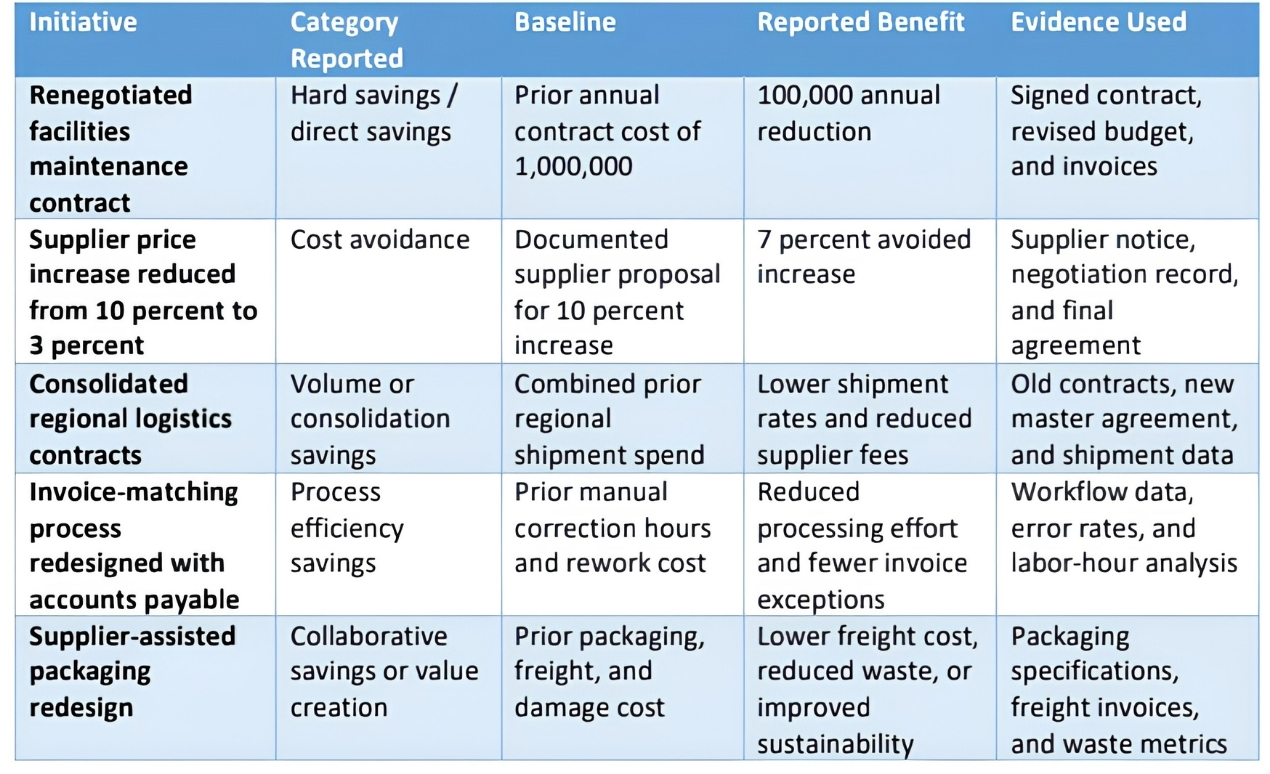
These examples show why the same procurement activity should be reported according to the benefit it produces. A renegotiated contract may be counted as hard savings when it reduces the approved cost base and the reduction can be verified through the signed agreement, budget, and invoices. A negotiated reduction to a supplier’s proposed increase should be reported as cost avoidance because the organization is avoiding a future cost rather than lowering last year’s spend. A collaborative initiative may be reported as savings if it reduces measurable cost, but it may be better shown as value creation if the main benefit is service quality, sustainability, resilience, or innovation.
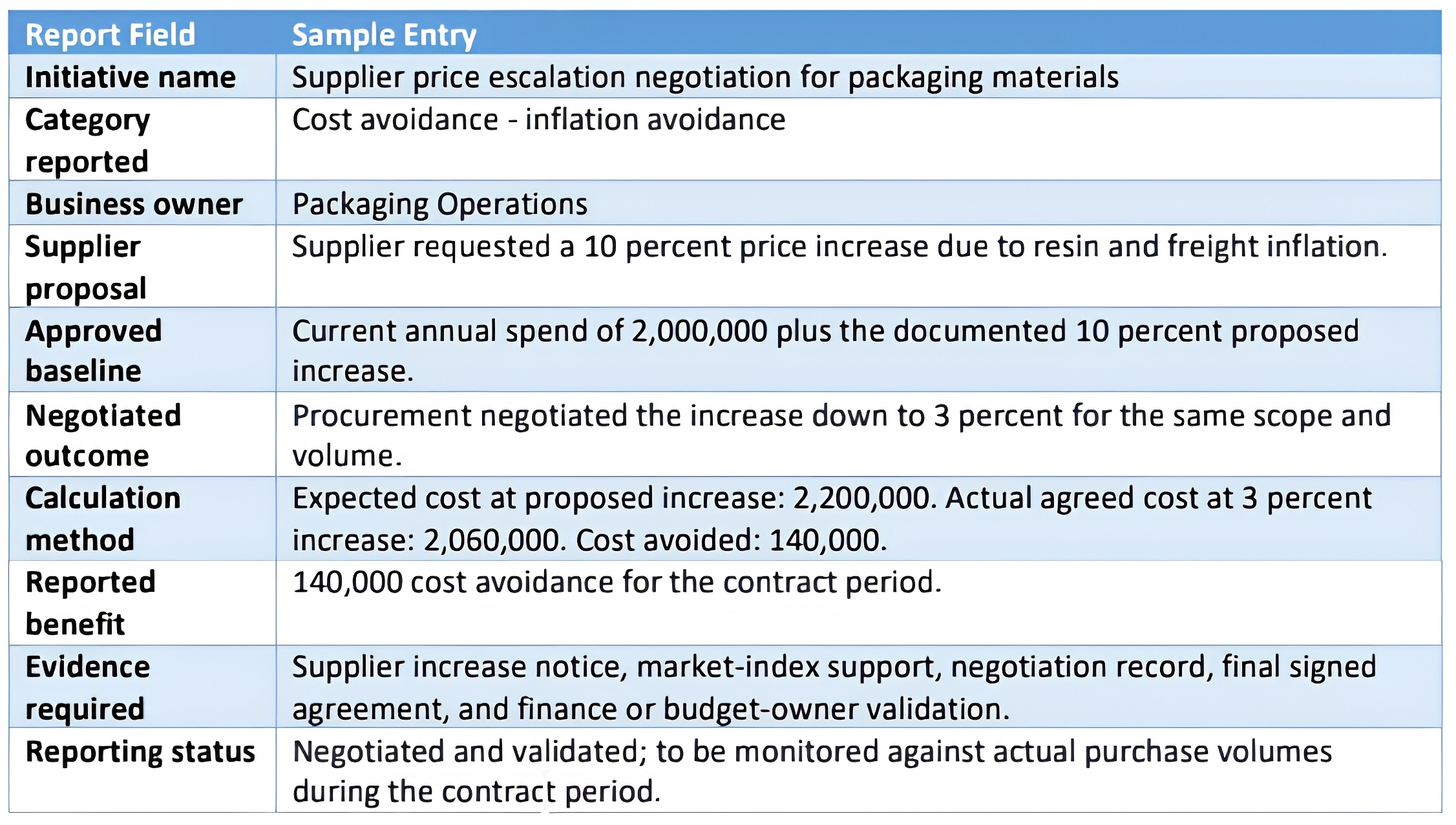
This sample shows that cost avoidance reporting should make the would-have-been cost explicit. The avoided amount is not the full negotiated contract value; it is the difference between the documented expected cost and the actual agreed cost. This distinction helps prevent overstatement and gives finance a clear basis for reviewing the claim.
The amounts in the sample report are illustrative. In practice, the organization should apply its approved savings policy, use the relevant currency, confirm the period covered, and adjust the reported amount for actual volume, implementation timing, and any agreed exclusions.
Using this approach, procurement can present a complete value story without overstating its impact. Hard savings can be shown as reductions to current or budgeted spend, cost avoidance can be shown as protection against future cost increases, and collaborative or process-based initiatives can be reported according to the financial result they create. The result is a savings report that is more transparent, easier to audit, and more useful for leadership decision-making.
Procurement cost management should therefore be built on more than negotiation results. It requires clear baselines, category strategies, supplier performance management, demand control, contractcompliance, and a shared methodology with finance. The procurement team should define savings types before initiatives begin, agree how each benefit will be calculated, and track whether negotiated value isactually realized through buying behavior. Without this discipline, savings can remain theoretical even when contracts look favorable.
Ultimately, procurement cost management is not about pursuing the lowest price at all costs. It is about improving the organization’s economic position while protecting quality, continuity, risk, and long-term supplier value. Cost savings show where procurement has reduced the current cost base. Cost avoidance shows where procurement has prevented future cost pressure. Process improvements can contribute to either category, depending on whether they reduce existing costs or prevent future ones. Together, when measured transparently and reported separately, these categories provide a more complete picture of procurement’s contribution to business performance.
• Institute for Supply Management, ISM Glossary of Key Supply Management Terms.
• APQC, Procurement Benchmarking and Cost Avoidance Measures.
• GEP, Cost Avoidance vs Hard Savings: How to Better Measure Procurement’s Impact.
• Simfoni, Procurement Savings Definition, Measurement, and Reporting Guidance.
• Lapasar, Cost Avoidance and Cost Savings in Procurement.



