
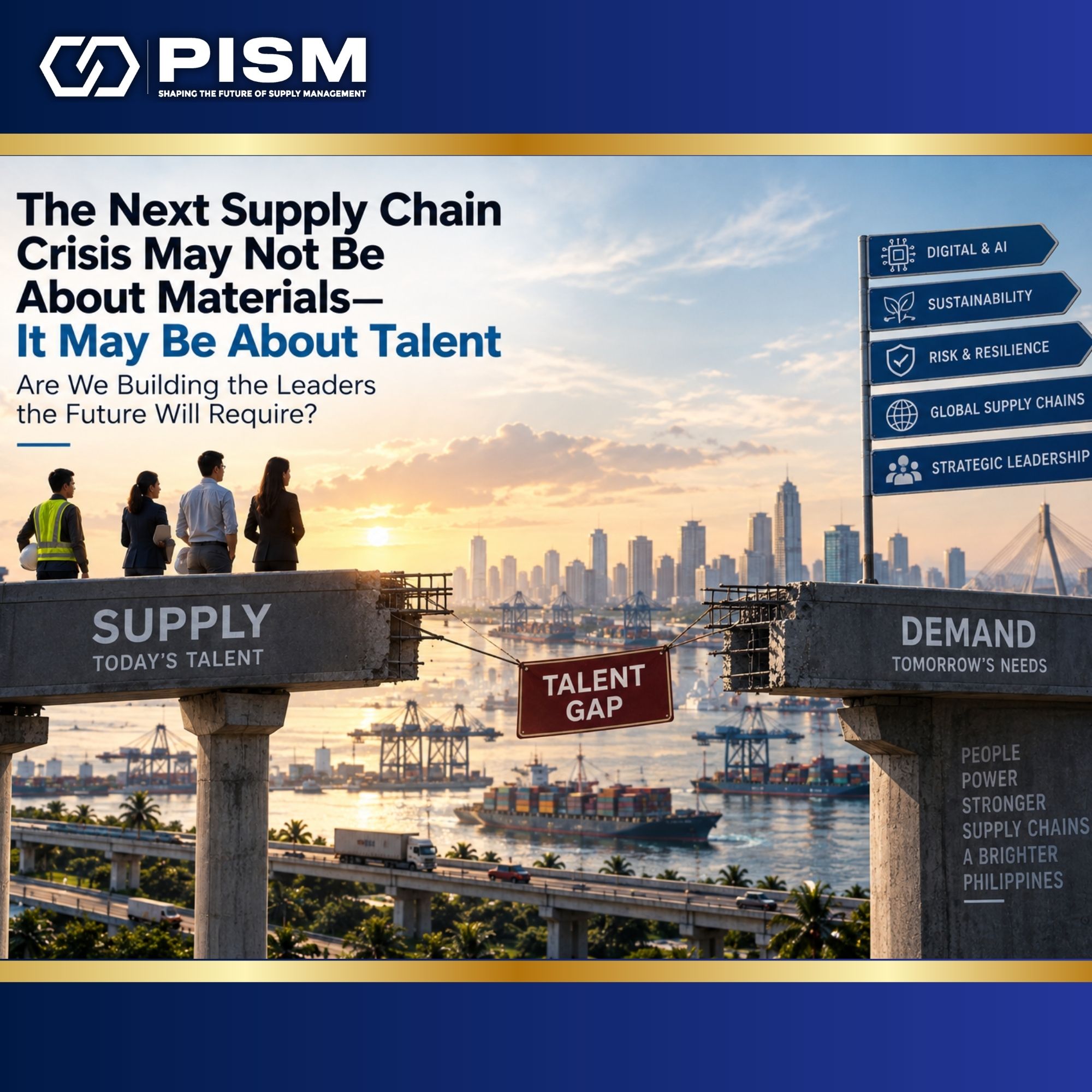
Are We Building the Leaders the Future Will Require?
When we talk about supply chain risk, the discussion usually turns to materials, logistics capacity, inflation, geopolitical uncertainty, supplier disruption, technology, and climate-related events.
These remain important. But there is another risk that deserves greater attention: Talent.
The Philippines has a strong pool of supply chain professionals across procurement, planning, logistics, sourcing, operations, analytics, and supplier management. The concern is not simply whether we have enough capable people today. The more important issue is whether we are developing enough people who can lead the increasingly complex supply chains of tomorrow.
This is an important distinction.
Organizations are generally good at filling vacancies. When a buyer leaves, another buyer is recruited. When a planner resigns, a replacement is found. When a management position becomes vacant, we look for someone with comparable experience.
The position gets filled, but has the organization's capability actually become stronger?
Talent development should therefore go beyond replacement. We need to think more deliberately about the capabilities our organizations will require in the years ahead.
The Capability Requirement Is Changing
The supply chain professional of the future will need more than functional expertise.
Commercial judgment, digital and AI fluency, data literacy, sustainability, risk management, strategic negotiation, and stakeholder influence are becoming increasingly important. Equally important is the ability to make sound decisions when information is incomplete and circumstances are changing.
Technology reinforces this need.
AI can generate insights. Analytics can identify patterns. Systems can automate transactions. Digital platforms can provide greater visibility.
But people still have to interpret the information, understand the business context, challenge assumptions, balance cost against risk, manage relationships, and ultimately take accountability for decisions.
As technology becomes more sophisticated, the capability of our people must develop with it.
Otherwise, organizations may succeed in transforming their systems without sufficiently transforming the people expected to lead them.
From Talent Acquisition to Talent Architecture
This is why organizations may need to shift the conversation from talent acquisition to talent architecture.
Recruitment addresses an immediate requirement. Talent architecture looks further ahead: What capabilities will the organization need? What do we have today? Where are the gaps? And how do we deliberately build what will be needed tomorrow?
The approach does not have to be complicated. A practical methodology can follow six disciplines:
Assess. Understand existing capabilities beyond headcount, titles, and tenure. Look at technical knowledge, commercial judgment, digital capability, leadership readiness, and the ability to work across functions.
Anticipate. Look three to five years ahead. Consider how AI, sustainability, geopolitical risk, new business models, and changing supply networks will reshape roles and capability requirements.
Develop. Address the gaps through a combination of formal learning, mentoring, cross-functional exposure, strategic assignments, supplier engagement, and actual business challenges.
Empower. Give emerging talent increasing responsibility. Leadership cannot be developed entirely in the classroom. People need opportunities to make decisions, manage stakeholders, deal with uncertainty, and be accountable for outcomes.
Build the Pipeline. Connect development to succession and career progression. Potential successors for critical positions should be identified and developed well before vacancies arise.
Measure and Re-assess. Move beyond training hours and participation rates. Measure whether people are actually becoming ready to handle larger, more complex responsibilities.
In simple terms:
Assess → Anticipate → Develop → Empower → Build → Measure → Reassess
The methodology itself is straightforward. What matters is applying it consistently and connecting talent development with the future direction of the business.
Developing Talent Is Also a Leadership Responsibility
Talent development cannot be delegated entirely to Human Resources.
Supply chain leaders themselves have an important role to play.
We need to coach people, expose them to different parts of the business, challenge their thinking, give them difficult assignments, and gradually allow them to exercise judgment.
A procurement professional should understand finance and operations. A planner should appreciate commercial strategy. A logistics professional should be exposed to technology and sustainability. Emerging leaders should have opportunities to participate in discussions where difficult business trade-offs are being made.
This is how people move from executing tasks to understanding the business—and eventually to leading it.
Succession therefore needs to begin long before someone announces retirement or decides to leave.
Strengthening the Philippine Supply Chain Talent Pipeline
There is also a broader opportunity for the Philippines.
Industry, academe, and professional organizations need to work more closely together in developing future supply chain talent.
What businesses will require several years from now should already influence what we teach today. Industry can provide exposure to real business challenges. Academe can strengthen analytical thinking and professional foundations. Organizations such as PISM can help connect practitioners with industry standards, continuing professional development, networks, and evolving global practices.
This collaboration is important if we want supply chain to become a deliberate career of choice for younger professionals rather than a profession, they discover only after entering the workforce.
The Philippines has the potential to develop supply chain professionals capable of assuming larger leadership roles not only locally, but across ASEAN, Asia-Pacific, and global organizations.
But potential alone does not create leadership.
Potential has to be identified. Capability has to be developed. Experience has to be provided. Judgment has to be tested. And eventually, leadership has to be entrusted.
A Different Measure of Success
Perhaps we also need to rethink how we measure talent development.
Training hours, certifications, and participation rates remain useful. But stronger measures may be found elsewhere.
Are more people ready to assume greater responsibility than they were a year ago? Do critical roles have credible successors? Are we developing more leaders internally? Are younger professionals gaining meaningful commercial, digital, and cross-functional exposure? Can they explain not only what they recommend, but why?
These are better indications of whether talent development is translating into organizational capability.
Because ultimately, the objective is not simply to develop better employees. It is to build stronger organizations.
The next major supply chain challenge may not come from a port, a factory, a geopolitical event, or another shortage of materials.
It may come when we discover that our businesses have transformed faster than the people we prepared to lead them.
For those of us already in leadership positions, this creates a responsibility that extends beyond today's performance.
We also have to prepare the people who will eventually take our place.
The question, then, is not simply whether the Philippines has enough supply chain talent.
Are we deliberately building the leaders who will carry Philippine supply chain forward?
Because leadership is not measured only by what we accomplish while we are given the opportunity to lead.
It is also reflected in the leaders we leave behind.
Article by: Gerard G. Magadia, hCPP



