
When orders weaken, it may seem reasonable to expect some pressure on suppliers and logistics networks to ease. With fewer orders competing for capacity, supplier lead times might also be expected to shorten.
The August 2026 Purchasing Managers' Index (PMI) Philippines results show why the relationship can be more complicated.
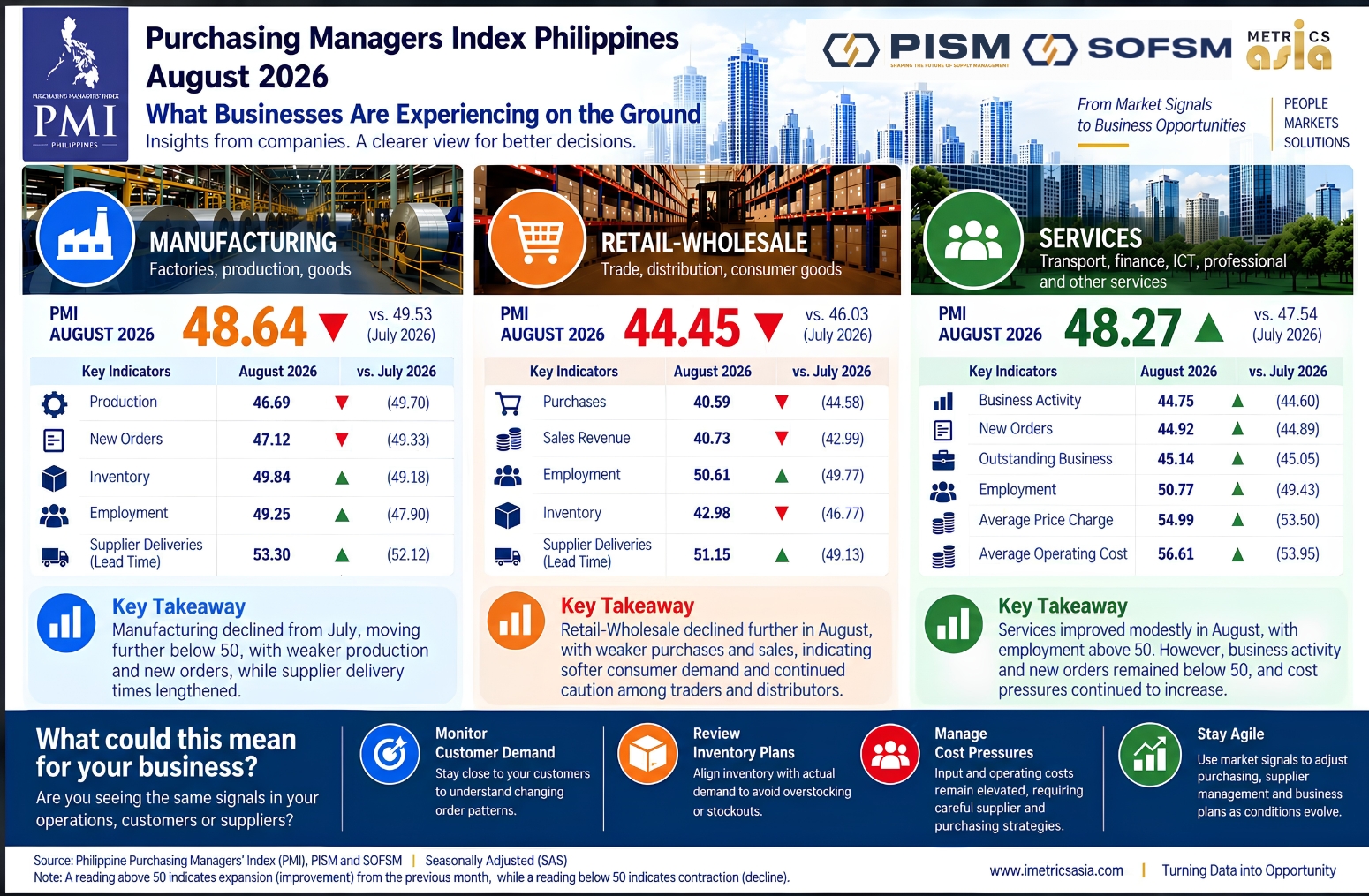
In Manufacturing, the New Orders Index declined from 49.33 in July to 47.12 in August. At the same time, the Supplier Deliveries Index moved in the opposite direction, increasing from 52.12 to 53.30 as supplier lead times lengthened.
A similar pattern appeared in Retail-Wholesale. Purchasing weakened further in August, while the Supplier Deliveries Index moved above 50.
For procurement professionals, this creates an interesting question: If orders are weakening, why might supplier lead times still be getting longer?
What is behind a longer lead time?
In the PMI, readings above 50 generally indicate an increase or expansion from the previous month, while readings below 50 indicate a decrease or contraction. The interpretation depends on what is being measured.
For Supplier Deliveries, the indicator measures the lead time between a company's placement of an order and the arrival of the ordered product. A higher reading therefore means that supplier lead times have lengthened.
Understanding why requires context.
Manufacturing respondents in August cited traffic, natural calamities, customs processing, weather conditions, and supplier delays among the reasons for slower deliveries. In Wholesale, the report also noted weather-related distribution disruptions and higher transport costs affecting the movement of goods.
This is an important distinction for procurement. The same visible outcome, a longer lead time, can emerge from different conditions. Capacity constraints, logistics disruptions, regulatory processes, and problems affecting an individual supplier may require very different responses.
Procurement also has an important source of intelligence that an external indicator cannot provide: direct conversations with suppliers. Asking what suppliers themselves are experiencing can help determine whether a constraint appears temporary, supplier-specific or part of a wider supply-chain issue.
The question therefore moves beyond “Why is my delivery late?” toward “What is changing in the supply network?”
Signal, Source, Scope, Response
A practical way to approach changing supplier lead times is through four questions: Signal, Source, Scope and Response.
Signal: What has actually changed? Examine lead times alongside orders, purchasing activity, inventory, and other relevant internal indicators. A single measure rarely provides enough context on its own.
Source: What may be causing the change? Supplier conversations, logistics information and operational data can help identify what sits behind the movement.
Scope: How widespread is it? Determine whether the change is concentrated in one supplier, category, location or route, or whether similar conditions are appearing across a broader part of the supply network.
Response: What action does the available evidence justify? Different causes can require very different responses, from supplier engagement and logistics adjustments to contingency planning or alternative sourcing.
The sequence matters. Investigating the gap between signal and response reduces the risk of solving the wrong problem.
Compare the external signal with your own supply chain
An external indicator such as PMI becomes more useful when compared with what a company is experiencing internally.
PMI provides a broader view of changing business conditions. Internal operational information provides another perspective through actual orders, inventories, supplier performance, customer commitments and service requirements. Suppliers can add further context about conditions elsewhere in the supply network.
The comparison can be useful even when the signals differ.
If broader supplier lead times are lengthening while your company's suppliers continue to deliver consistently, the difference deserves attention. Your categories may have different exposures. Your suppliers may be managing capacity differently. Contractual or logistics arrangements may also be providing greater stability.
The reverse can also happen. Your company may experience significant supplier delays while the broader indicator remains relatively stable. This may lead procurement to examine whether the issue is concentrated in a particular supplier, category, route or part of its own supply network.
The value lies in understanding what explains the similarities or differences.
This is also where procurement can move beyond monitoring supplier performance toward understanding supply conditions. Lead times, fill rates, quality, pricing and service levels tell us what is happening within particular supplier relationships. External indicators and supplier intelligence can provide additional context around those measures.
Better context can also improve supplier conversations. A delay caused by conditions within a supplier's control is different from one arising from a disruption affecting an entire logistics route. Supplier accountability remains important, but understanding the source and scope of the problem makes the response more precise.
A signal should trigger a question before an action
The August PMI Philippines results illustrate why procurement indicators are most useful when they lead to better questions. Orders weakened while supplier lead times lengthened, showing that supply-chain signals do not always move in the direction we might expect.
The movements occurred at the same time, but that alone does not establish that one caused the other. Understanding what sits behind them requires evidence from the company and its supply network.
External indicators can show what is changing more broadly. Internal data show what the company itself is experiencing. Suppliers can help explain conditions within the supply network.
Bringing these perspectives together is where procurement adds value.
Article by: Janette Toral, GICD
Sources: Purchasing Managers' Index Philippines August 2026 Manufacturing and Retail-Wholesale reports. PMI Philippines is a project of the Foundation of the Society of Fellows in Supply Management (SOFSM), the research and advocacy arm of the Philippine Institute for Supply Management (PISM).



